
By Jaden Jurvakainen · Updated October 2026
What Should You Look For in an Outdoor Sauna in Minnesota?
The short answer: Look for a sauna built for four seasons: real wall and roof insulation, a vapor barrier, siding and roofing that handle snow and freeze-thaw, and a heater sized to the room. Then plan the Minnesota details, meaning a pad that drains, a clear delivery path, and your city or county's rules, especially on a lake lot.
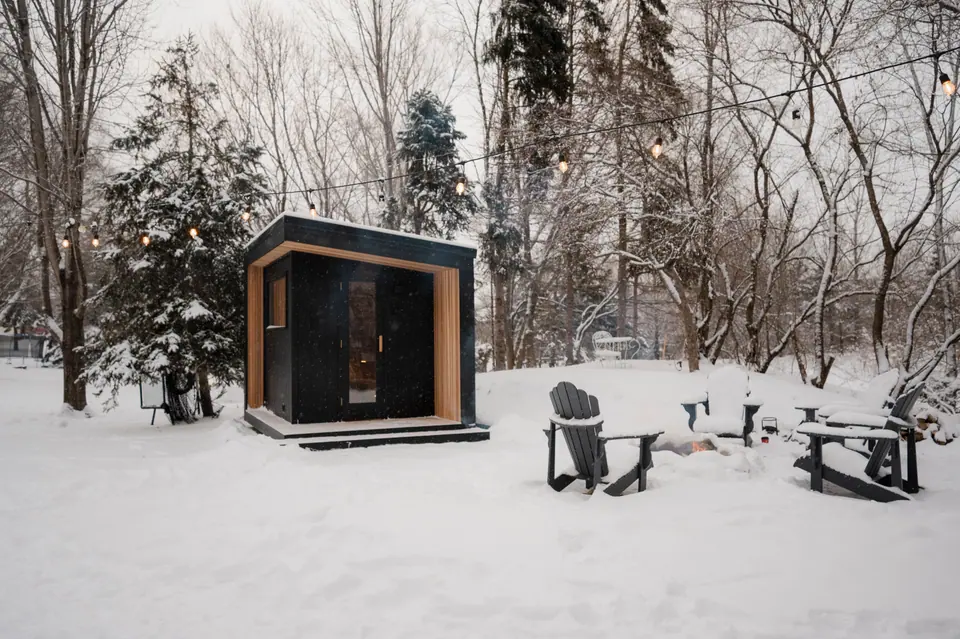
A sauna that does fine in a mild climate can struggle here. Minnesota asks a small building to hold heat in subzero cold and to sit through snow and freeze-thaw cycles year after year. This guide covers the parts of buying an outdoor sauna that are specific to this state.
If you want the general order of decisions first (size, heat, layout, site, permits, budget), start with our buying checklist.
What four-season construction means
In Minnesota this is the part that matters most. A sauna meant for year-round use should have:
- Correct insulation thickness in the walls and the roof
- A properly installed vapor barrier
- Weather-resistant siding
- Metal roofing designed for snow
- Cedar interior cladding
- A planned ventilation layout
- A heater sized to the room
Miss any of these and you risk heat loss, condensation problems and a shorter life for the building.
This is where kits and custom builds part ways. Many of the kits sold online are mass-produced, with lower insulation performance and limited options. Some are not designed for snow load, and all of them need assembly. They can work in milder climates. Minnesota winters demand more.
Our saunas are built by our own crew for this climate. A typical exterior is black board-and-batten with a clear cedar entry, and the interiors are cedar on the walls, ceiling and benches. A custom build in Becker is clad in shou sugi ban, chosen for durability as much as looks.
Winter performance
Heat-up takes longer in deep cold
An outdoor sauna takes longer to reach temperature in January than in June. In our indoor vs. outdoor comparison we put a well-insulated outdoor sauna with an electric heater at roughly 45 to 60 minutes in subzero weather. Insulation and a correctly sized heater are what keep that number reasonable.
Getting the room hot before you walk out
Electric heaters with WiFi controls help a lot in winter. Our builds in Chanhassen and Mound both use an IKI Pillar electric heater with WiFi controls, so the sauna can be heating before anyone leaves the house.
Cooling off is the point
Stepping into winter air after a hot round is a big part of why people here love their saunas. Plan a place for it. A covered porch works well, and so does a deck. In Monticello, the homeowner extended the deck off the front of an 8x16 wood-fired sauna to hold a cold plunge and an outdoor shower.
One of our builds takes this further than any other. We built an 8x16 mobile sauna for a north metro client with a trap door in the dressing room floor. Pulled onto a frozen lake in January, it opens straight down to the water.
The pad: drainage and frozen ground
An outdoor sauna needs a stable, level base that drains well. A gravel pad is the most popular choice among our customers. Concrete pavers, a small concrete slab and a deck platform engineered for the weight are the other common options.
In a state with freeze-thaw cycles, drainage is the part to get right. A base that sheds water protects the sauna from moisture problems and shifting. If someone else is building your pad, ask how they plan to handle frost in your soil.
Most of our customers finish their base in a single weekend. We provide a foundation guide for every model.
Lake lots
Several of our builds sit on lake properties, and each one was planned around the water.
- Island Lake, near Sturgeon Lake. A Tuli sits at the edge of the lake between the pines. The window gives a clear sightline through the trees to the water, and the dock is a short walk from the door.
- Longville. A wood-fired sauna with an IKI stove has large windows facing the nearby lake. It also has a roomy dressing room and an oversized porch for cooling off.
- Lower Eau Claire Lake, near Gordon, Wisconsin. Our Superior build on a bluff has a large window placed so the upper bench looks straight out over the lake.
- Clear Lake. A wood-fired sauna built in our shop and delivered to a site overlooking the Mississippi River.
Two pieces of advice for lake owners. First, plan the window and the bench height together, because the view only works if the seated sightline is right. Second, lake lots often have their own setback rules. Your county or city zoning office is the one to ask, and it pays to ask before you get attached to a spot.
Delivery
We build each sauna in our shop in St. Bonifacius and deliver it finished. There is no weeks-long construction project in your yard. That also means the delivery path needs as much thought as the pad.
Look at these before you choose a location:
- Tight spaces and narrow gates
- Slopes and uneven ground
- Long driveways
- Delivery distance
We deliver well beyond the metro. One Superior went to Joice, Iowa, and we have built for clients in Wausau and Gordon, Wisconsin.
Sometimes the site calls for work on location. For a Tuli in Mendota Heights that had to fit with the homeowner’s existing deck, we built the wood-fired heater installation on site to handle the constraints there. We also help with site planning and coordinate with electricians and other trades. Our sauna installation page has more on that.
Real builds by town
| Town | Build | Heater | Details |
|---|---|---|---|
| Minnetonka | Tuli | IKI electric | Dark vertical siding and a cedar soffit, set under mature trees |
| Chanhassen | Custom, 7x10 hot room | IKI Pillar electric with WiFi | Oversized window facing the backyard |
| Mound | Tuli | IKI Pillar electric with WiFi | Entry porch and a large viewing window |
| Ham Lake | Custom 8x14, two zones | IKI Mini Wood | Changing room that leads into the hot room |
| Monticello | Custom 8x16 | IKI Original wood | Dressing room, plus a deck for a cold plunge and shower |
| Longville | Custom | IKI wood | Lake-facing windows, dressing room, oversized porch |
Choosing a heater for a Minnesota property
Wood-fired stoves give deep, radiant heat and do not depend on an electrical upgrade, which makes them a strong fit for rural properties and cabins. Electric heaters start faster and suit daily use. The right choice depends on your property and how you plan to use the sauna.
Size and price
The 6 to 8 person size is the most common choice, and many owners say they wish they had built slightly larger once the sauna became part of their week.
- Kota: 6x8, 4 to 6 bathers, typically $20,000 to $30,000
- Tuli: 8x12, 6 to 8 bathers or more, typically $30,000 to $40,000 (our most versatile model)
- Superior: 8x16, 8 or more bathers with a changing or lounge room, typically $50,000 to $60,000 and up
- Fully custom builds, such as two-zone layouts and covered porches: $35,000 to $65,000 and up
Try one first
A Northern Steam Tuli with an IKI electric heater is the sauna at Nordic Escape in St. Michael. Nordic Escape is a separate business, and you can book a session there to feel one of our saunas before you plan your own.
When you are ready, tell us about your yard or your lake lot: where the sauna would sit, what the access looks like, and how you plan to use it in January. We will help you work out the rest.
Related questions
Quick answers
Can you use an outdoor sauna in a Minnesota winter?
Yes, if it is built for it. A four-season sauna needs proper wall and roof insulation, a vapor barrier, weather-resistant siding, roofing designed for snow and a heater matched to the room. Cold weather is no reason to skip it. Stepping out into winter air between rounds is part of the appeal.
Are outdoor sauna kits good enough for Minnesota?
Some are, but check before you buy. Many kits are mass-produced with lower insulation performance and limited options, and some are not designed for snow load. Ask the seller about insulation, the vapor barrier and the roof. A sauna built here for snow and freeze-thaw cycles typically holds up better over time.
What is the best base for an outdoor sauna in Minnesota?
A stable, level base that drains well. Most of our customers use a gravel pad. Concrete pavers, a small slab or a deck engineered for the weight also work. Drainage matters most here, because a base that sheds water protects the sauna from moisture problems and shifting through freeze-thaw cycles.
Can I put a sauna close to the lake at my cabin?
That depends on your county or city. Lake lots often have their own setback rules, so ask the local zoning office before you pick a spot. We have built saunas on lake properties near Sturgeon Lake, in Longville and near Gordon, Wisconsin, and we plan the windows and benches around the view.
What size outdoor sauna do most Minnesota homeowners choose?
The 6 to 8 person size is the most common. Our 8x12 Tuli fits that range and is our most popular model. The 6x8 Kota seats 4 to 6 and suits compact yards, and the 8x16 Superior seats 8 or more. Many owners say they wish they had built slightly larger.